Showing posts with label LDStorymakers. Show all posts

Wednesday, June 6, 2018

The Downside of Boy vs. Girl Books


I enjoyed a fabulous writer's conference, LDStorymakers, in Utah last month. Twelve classes provided great motivation, information, and ways to improve my craft. I reconnected with friends, my critique group, and met my new cover designer for "Samuel's Sword", coming out later this summer.

The keynote speaker was Shannon Hale, who spoke about representing genders and our choices with writing/reading. Boys suffer the most because they are taught not to read "girl books". Stories ABOUT girls (vs. calling them stories FOR girls) teach empathy toward females that males are missing. Girls get to read anything, but boys face social ridicule. We need to change that. Boys who learn to understand the feelings of girls will likely grow up to treat women better than those who don't.

Hale quoted some of her findings with industry sexism. On average, animated movies present 11 male main characters to 4 female. Crowd scenes portray 80% males. Male authors are typically promoted more, even by librarians. Hale has been invited to speak to school groups where the boys were not invited. What are we teaching boys? Hale encouraged that our voices matter. We should teach the ways we are more alike than not alike. We should not pre-select for others but enjoy the whole human experience. Loved it!

Monday, May 18, 2015

Keynote Adress at Storymakers 2015 - Martine Leavitt

Just got back from my favorite Writer's Conference--LDStorymakers. Loved the classes, seeing friends, and getting inspired. For me, the keynote address by Martine Leavitt was one of those inspiring moments. She shared her own personal journey to success and how we need to believe in ourselves.

Martine compared herself to her talented sisters. In trying to find her own area to excel, she turned to writing since she loved to read. Trying held as much frustration as satisfaction. Finally the day came that she didn't throw away what she wrote the previous day. She sent off several articles, which were rejected. What was with that? Did she have to do more than convey a meaning? Maybe it should be interesting, original. Maybe she should think of the reader. Martine learned humility.

Craving more time to write, Martine made tough choices while raising a family and serving in her church. She remained true to a commitment to write every day, even if for a few minutes. It made her happy, but also taught the value of each word. "Write each word as if it is special," she said. "A parent who is happy because she writes is worth a lot."

Life threw some curves Martine's way. She became a single parent, remarried, had a large family, new job, etc. She learned that the way you live matters. Service gave her a new type of love to be a better writer. We need to hear the hearts of others. We need to believe in ourselves and be humble. We need the influence of the best books, children in our lives, and learning to love.

What I write shouldn't be determined by others. There are those that think Mormon writing is filled with too much sunshine. Gray areas are not as interesting as darkness where light breaks through. The world hungers for the types of books we can write. Make a work of art of ourselves and believe.

A couple of her thoughts on talent:
Talent can be dangerous because you might believe you don't have to work hard.
Believing you have a talent gives a responsibility to it. Believe.

Monday, December 15, 2014

This week I joined the frenzy of signing up on the first day for my favorite writer's conference, LDStorymakers. Being on Pacific time, I even set my alarm to make sure I had things ready to go on time. The system had an overload or something, but shortly after that was fixed I had registered and signed up for the pre-registration intensive class I wanted most. Hooray! (The regular sessions do not need pre-registration.) This was my main reason for signing up early--last year the intensives filled before I registered. Others scrambled to get pitch sessions or manuscript consultation.

Great things (including but not limited to) about having a favorite conference to attend each year:

  • Connecting. Seeing old friends and online friends in person.
  • Networking. Getting your face and name out there, finding collaborations, meeting agents and publishers.
  • Familiarity = Comfort. Being comfortable with the way things are run, fewer surprises, appreciating subtle changes.
  • Repeats. Taking the class(es) you missed out on last year.
  • Fun. Rejuvenation. Getting pumped up again.
  • Audience. Attenders at this conference are among who I read and who will read my books.

For more information on this wonderful conference held in Utah May 15-16, 2016, visit http://storymakersconference.myshopify.com/.

Monday, May 27, 2013

LDStorymakers Conference Highlights

Author's Incognito Mix and Mingle Attendees
Roommates: Alex, Renae, Emily, Angela
It's like a drug. Bursts of enthusiasm and creativity pulse through your body. There's the high of seeing friends and making new ones. You fight to keep all that good info tucked into your gray mass because there is so much to soak up. Thank goodness for notes. That's what a good writer's conference can do for you.

Speaking of notes, Ali Cross and RaShelle Workman put on a great class with lots of notes about self-publishing. My toes are dangling over those waters so I'm in an info-gathering mode there. I'll let you know what happens.

Josi Kilpack delivered what is needed in a first chapter with her class Bait and Hook. Many of those needs: active voice, strong verbs, a great first line, dialogue, conflict that matters, and enough of a cliff-hanger to lead readers to chapter two. I found it interesting how much time she spends on her first chapters. Her critique group gets those pages over and over but they don't always see the rest of the book. Why? Not only do we only get one chance to make that first impression, first chapters are often used as bait/advertising to hook readers to buy the book.

One last highlight I'll mention today was Sheralyn Pratt's class on Creating Compelling and Believable Action. One of her tips was to do what you write. This meant that for her to write that skydiving action scene, she needed to experience it for herself. Whoa! That gives realism relevance. Fun to listen to and great info. That's what a good conference can do for you. 

Monday, May 20, 2013

Writing Twists and Turns

Don't you just love a story with a good twist at the end? We like the surprise, the freshness of the path less traveled. But why limit a story to one good plot twist? Readers may not always recognize every Story Turn they happen upon--especially the small story ones. 

Story Turn is where the reader is set up by the author to expect something dramatic or a change. It could be as simple as having a rough character momentarily show compassion or humor. Okay, so this may not be considered a plot twist, but it is a Story Turn and it affects the pacing of the story. It raises new questions and greater curiosity. Story turns are for the reader, not the characters in the story, sais John Brown in the LDStorymaker conference class I attended last week. "Readers want to puzzle and worry," Brown adds. This questioning or worrying is often triggered by a 1) Threat, 2) Hardship, 3) Opportunity, or 4) Mystery. Brown uses the acronym THOM. Not all Story Turns have to be positive or negative, and they should be varied within the story.

Brown suggests brainstorming for possible twists and turns. Work forward with a Story Cycle or backward with a Step List. What the writer is going for, according to Brown, in planning a Story Turn is to first incite a question or problem. Secondly, a THOM is presented to cause a different action than anticipated. These turns occur at the structural and scene level. We need the main question raised in the beginning to be answered in the end AND we need a turn or mini-turns in each scene to drive the pace. See if this short quiz strengthens your understanding.

Which THOM is used for the main story question in the following book/movie?
     1) Les Miz
     2) Jurrasic Park
     3) Pride and Prejudice
See how well you did? Now that's what I'm talking about! Now figure out the THOM for one of your favorites.


Monday, May 13, 2013

Anne Perry - Keynote Address


Oh my gosh, what a great writers conference!International bestseller Anne Perry inspired attendees with a powerful keynote address Friday at the LDStorymakers Conference in Provo, Utah. She began with a connection to the past through words and storytelling. Greek mythology and Bible stories were mentioned. The importance of words was further emphasized when Perry turned  her remarks into a personal pep-talk to each listener. "Books give companionship, knowledge, beauty," she listed. "Maybe your words could give this to someone else." Sharing emotion, from laughter to grief, were encouraged. "Put it down with your heart . . . You can do it." So good to have a cheerleader of such renown. So glad I was there. I hope passing along these thoughts has helped to make your Monday more meaningful (or any day you read this.)
I will share thoughts and snippets of what I learned from the conference in the next few posts. Please check back and I hope you have a great week!

Monday, May 21, 2012

How to Worry Over the First Scene

  Writers talk about how essential that first sentence, first paragraph is in hooking your reader. Does it have to be full blown action-packed? Elana Johnson and James Scott Bell both say no. Let’s find out what it does need.
  At the LDStorymaker Conference I recently attended, Elana presented the beats of a novel as adapted from Blake Snyder’s Save the Cat books. The first beat is the opening scene. “You show your main character in the ordinary world in which they live,” Elana stated. Speaking of the opening scene for Possession, she adds, “Mine was a walk in the park.”
  James writes that people read to worry. Put your character in some kind of discomfort or danger, big or little. This is a disturbance, not high levels of action. The reader will side with someone in trouble and their connection to the character begins. The faster we worry, the faster we bond.
  So, while Elana shows the opening image of Vi’s normal world—a park, she also hints that trouble will follow her as she breaks the rules and that it will be recorded by the government. We have an immediate disturbance and our curiosity is peaked.
  Go back to that first page of the book you are reading or the novel you are writing. Does it have a disturbance by the end of the first paragraph? Do we have someone starting a new school, losing their job, or worried about an exam? Hopefully yes. Is there tense action already? Will the building suddenly explode or is the heroine tied to the railroad tracks? Probably not.
  Events will soon build, but first we want an intriguing disturbance in the character’s world. Happy worrying.
  
<><>
<>


Top: Local friends Me, Angela Milsap, Brenda Sills
Middle: My Roomies Angela and Emily
Bottom: My door prize win - With Karen Hoover who signed her book,
Misadventures of a Teenage Wizard. I also won Possession and Texting Through Time.


Monday, October 10, 2011

Award-Winning Entry

  Thrilled to receive notification of First Place for the second time this year, I am including an excerpt from the winning entry for my post today. The complete chapter won first place in contests for both the 2011 LDStorymakers and League of Utah Writers (LUW) conferences. I am honored to share this with you and hope you enjoy reading it.
THE SEVENTH CITY 
Chapter One 
About 90 B.C.
  Princess Karlinah hid a secret that could kill her. It felt as if it were buried in the pit of her queasy stomach. She quickly lowered her head as she approached her father-in-law where he glowered upon his throne. His scowl mirrored her husband’s while she fought with him last night. Shaking off the image, she bent her knees to the tiled floor and bowed. She rose when invited, keeping her gaze just below the king’s eyes. “You sent for me, great one?”
  The Lamanite king of the land of Jerusalem dipped his feathered headdress in reply and sent back the servants waving palm fronds. He stood and motioned Karlinah forward.
  Karlinah trembled. Dread filled her as awareness of the private nature and seriousness of the conversation increased. He meant to accuse her, she just knew it. She struggled to push her feet forward, took two slow breaths, and looked at him.
  “There is no easy way to say this.” His matter-of-fact voice belied the gravity of his words. “My son is dead. Murdered.”
  “Murdered?” Karlinah echoed, eyebrows raised. What a strong word to describe what had happened to her new husband. But she would never get the chance to explain. Regretting that the word slipped, she covered her mouth with her hand. It might have sounded like a confession for how nervous she must look. A quivering gasp escaped her lungs as Karlinah locked eyes with his. Had she betrayed herself?

More about The Seventh City:
A secret. A death. A spirited, sixteen year-old widow. For the young, Mayan princess it was either kill or be killed. Then a Nephite missionary comes to preach about repentance. Can Karlinah gain acceptance and remarry without revealing her secret?
I am currently revising the rest of the manuscript in preparation for submitting. 

Monday, May 30, 2011

Conflict and the Mechanism of Story, Part 2

Clint Johnson—Conflict and the Mechanism of Story Part 2
  Conflict is the high-grade fuel of a story, the drama, the reaction of resistance, not just tension.
Dramatic Conflict needs: 1) Need. Character needs something, a motivation. This need breaks the character from routines of life and creates action. Tip: We don’t want real life, we want an assimilation of real life. 2) Opposition. Opposition to the above need must be equal to or greater than the need itself. 3) Action. What the character does, says, thinks, to overcome the opposition. This includes internal and external action.
  How your character responds to your plot=the real story. What do they want for themselves and others?
  Central needs for youths: Individuality with community or trying to become someone he/she is please with that others can accept while there is opposition.
  Nonfiction: The perception of a need, not creating one. Use the point of view in which you can be honest; this is your point of view for someone else’s story. Show why they might have done something. Use Need, Opposition, Action in non-fiction too.
  Like a person with chronic pain, we adjust or adapt. In order for it to feel like things are getting worse (rather than adapting to the crisis or pain), conflict has to increase at a significant rate/pace. There are little breathing places of relief along the way before the next stomach punch.
  The main character has a need that motivates them into action. If the need isn’t achieved, what will happen? What is at stake?
1) External/Public Stakes: Social, often large scale, plot driven, world ending.
2) Internal/Private Stakes: Poignant, individual, self-worth.
  Weave both external and internal together. A stake affecting multiple people will intensify it. (Having to diffuse the bomb before the building explodes.) A stake affecting a significant person will broaden, complicate it. (Having to diffuse the bomb in the building where your wife works.) How far you push depends on the story/genre you want to tell. Take your characters into places the reader didn’t want to go. Comedy takes pain. Love characters for their flaws. Happiness has to be earned or it is resented. Endings can be win, lose, or draw.
Clint had us think of a story idea we wanted to write. Then he asked us to 1. think of an internal stake for the MC and, 2. how can you intensify it? Conflict it of major importance to a story and something I've struggled with. I hope these tips help you as well as me.

Monday, May 23, 2011

Conflict and the Mechanism of Story

LDStorymakers Conference Notes #2:
Clint Johnson—Conflict and the Mechanism of Story Part 1
  Writing is primarily a craft/skill that can be learned. If you work hard enough, you will be published. Writers need two dominant skill sets: 1) Language—learned by exposure, and 2) Narrative/Story—universal human language. Take conscious control over your own creative process.
  Components of Writing were compared to an engine. You need more than a spark plug. You need all the parts put together. Think of the story as a whole and conflict is the fuel. Conflict is the most essential component. We want high grade fuel.
Components:
  1. Conflict forces action. Characters don’t want to break routines or risk failure. Conflict forces them to act or go away from routine.
  2. Action reveals character. These actions show who they are.
  3. Revealed character facilitates reality. Characters do things that feel authentic, make the distance between reader and story narrow. Reader believes.
  4. As disbelief is suspended, identification increases (identify with characters). Begin with an individual instead of something universal. The individual will go toward the universal and a broad audience can identify with it.
  5. Transmission of emotions/meaning. We tell stories to figure out what they mean. Even data has to be interpreted. Lead the reader into a different place through one set of facts. Story = mechanism of meaning. This is how we are wired to think.
  Don’t write for interest/theme sake. Write for emotion. Some people read for ideas more than emotion. Someone interested in your story idea will pick it up anyway. We read for a vicarious experience of emotions.
  You might want to try this exercise Clint has us do. Start with a story idea you want to write about. 1. Identify a protagonist need. 2. Identify an opposition to that need. 3. Identify the initial action the protagonist will take. This is a good way to start your story. Good luck!

Monday, May 16, 2011

Refining Your Writing

LDStorymakers Conference Notes #1:
This week I’ll share some thoughts from Angela Eschler of Eschler Editing on Refining Your Writing. Angela hit upon various topics of interest. I’m certain you’ll find something of interest too.
Conflict: Characters need goals—even little ones—in each scene. Action is interesting but the reader needs to wonder about the characters. The end of a scene should meet with disaster toward the goal. The character then has to do something else to accomplish the goal, moving the plot forward. Pacing slows when the reader loses track of whatever the character cares about/the goal is interrupted. The point of view should stay with the character needing the goal or the one who is preventing it. Page Turner Tip: End the chapter before the goal is met.
Setting: Incorporate the characters into the setting; give a sense of them in the description. You can use the setting as the voice of the characters and tell their emotions without saying it directly. A character stuck in a setting can add tension.
Hook: Anything that makes the reader want more, questioning, create tension, emotionally grabs the reader. The hook should hint at the plot problem together with emotions. It foreshadows more than one problem or theme. Quirky characters and settings are hooking. Take it deeper.
Endings: A little loss and a little triumph equal a satisfying ending. Earned endings are best.
Power of Language/Trimming: Can you cut 2-4 words from each sentence for economy? It should not change the info or meaning. Use Search and Find. Cut anything repetitive where you’ve used different words. Don’t spell out what can be told in other ways. Make certain that metaphors start with something familiar and are applied to the unfamiliar. If they don’t share insight, cut it.
Find a tidbit you liked? I'll share more next Monday. Thanks for stopping by.

Monday, May 9, 2011

First Chapter Contest Award

  Wow! Just came back from an awesome writer’s conference—LDStorymakers. You know what they say: The more you learn, the more you learn you don’t know. It’s a mixture of that and recognizing concepts I’m “getting”. Though harder to implement, I can recognize more of what needs work in my current project. Sometimes it’s overwhelming because it takes revision after revision . . . . I think it’s impossible to catch all those things in one sweep or even to write thinking of all the concepts in my head. Practice, practice.

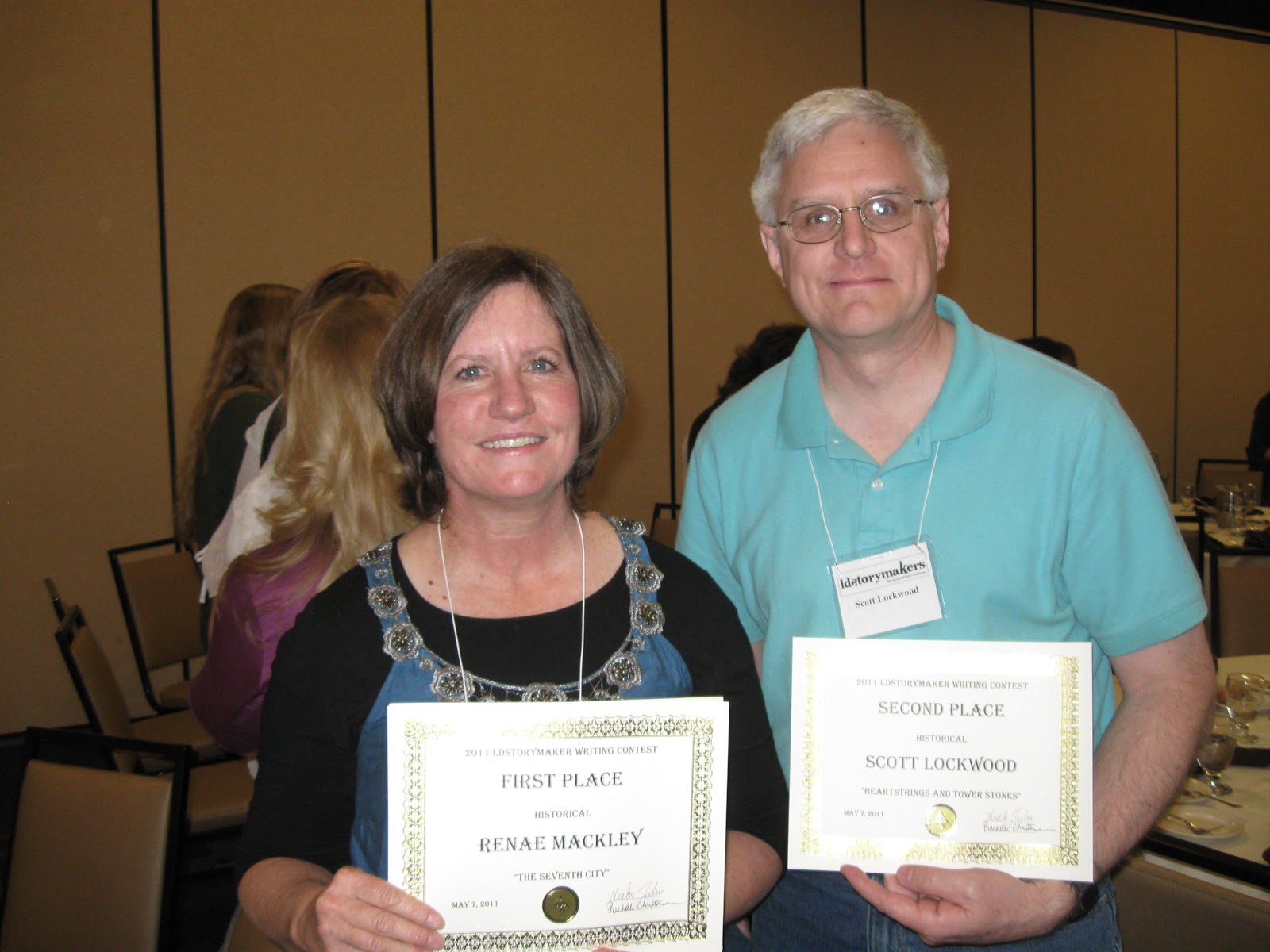
Historical Winners-Me and Scott Lockwood
  Drum roll please. There must be some things I’m getting right because I got great news when they announced the chapter contest winners. My Historical Fiction chapter won 1st Place in that category! It feels like all the effort was worth it. One of the biggest perks is that 3 LDS publishing companies will view my manuscript immediately instead of placing it in the slush pile of entries.
My best critic and supporter, Melissa Cunningham


Judgment Day. Four judges evaluated my submission and gave feedback. This is always a touchy subject for the entrants; it can really vary. Typically there is a harsh judge and an easy judge. This time the harshest judge left comments indicating his/her reasoning or train of thought that led to their rating. Thank you, whoever you are. Now I can make a better decision of what to fix because of those reasons and not wonder if the judge ate something disagreeable for breakfast.
  Writing Tip: When we get feedback from a judge, a critique group, or even a friend, try to evaluate it in the perspective of what you have learned about the concept instead of emotional attachment to the writing. Can this feedback strengthen the writing?
  Head Back next Monday for specific tips and information from a class or two.